Quick Answer:
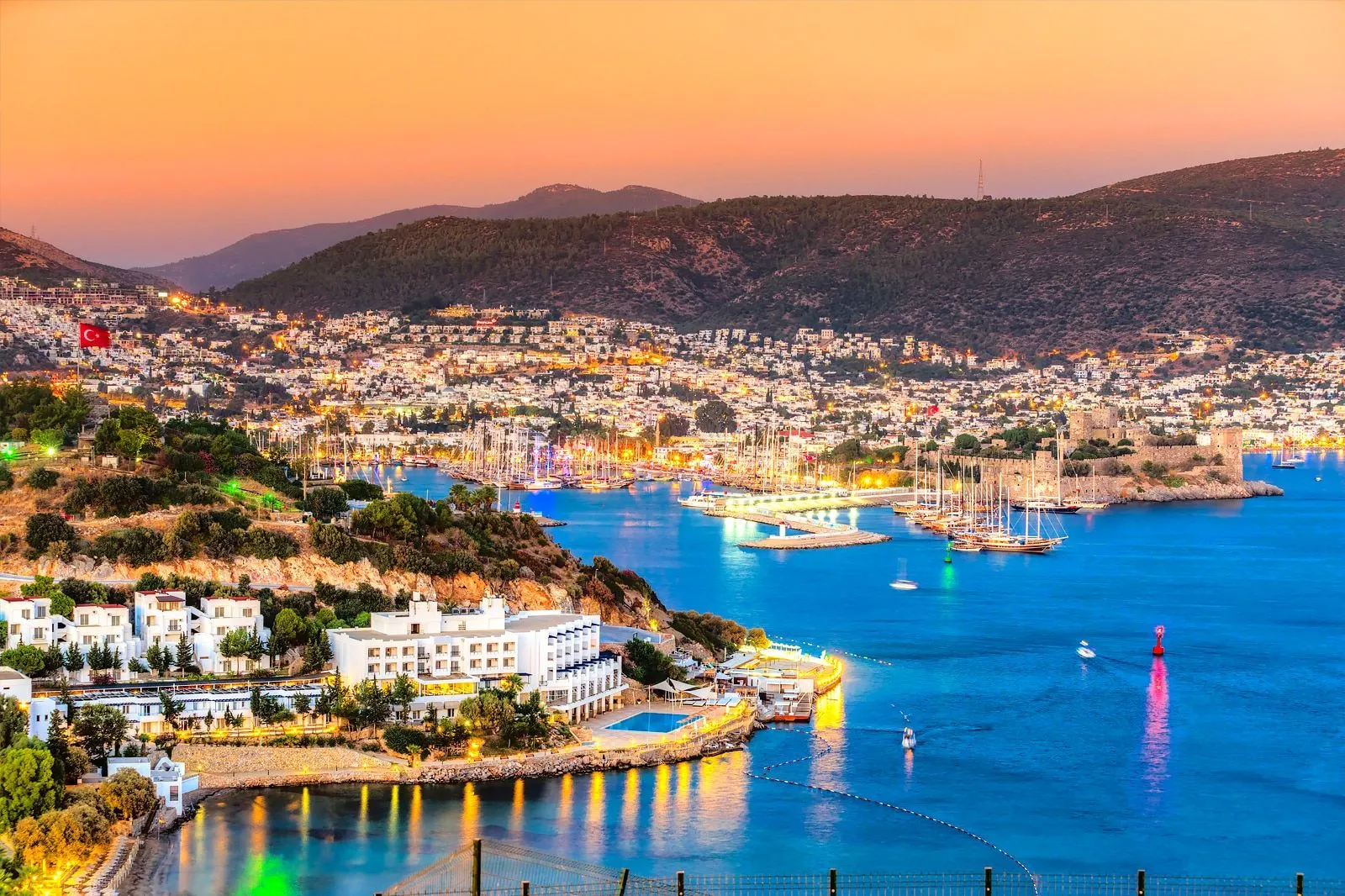
Bodrum is not simply a beach destination — it is a 2,500-year civilizational layer compressed into 70 kilometers of volcanic coastline. The peninsula spans from Bodrum Merkez (home to the Castle of St. Peter and the ancient Mausoleum of Halicarnassus) to the mega-yacht hub of Yalıkavak Marina in the northwest and the ultra-private Gulf of Gökova wilderness in the southeast. Milas-Bodrum Airport (BJV) serves as the primary air gateway, with transit times of 40–75 minutes to outer luxury enclaves. The Meltemi wind system keeps peak summer heat (34–36°C) comfortable and breathable. Advance reservation of at least 2–3 weeks is mandatory for premier dining venues during the July–August peak window.
Last updated: June 2026
The Deep Chronicle: From Ancient Halicarnassus to Intellectual Sanctuary
To truly comprehend the pull of the Bodrum peninsula, one must look past the contemporary yachts and white plaster walls to the very limestone layers upon which it rests. Long before it was the playground of global capital, this southwest corner of Anatolia was Caria — a fiercely independent, culturally fluid territory positioned precisely at the crossroads of the Greek world, the Persian Empire, and the indigenous civilizations of Asia Minor.
The Indigenous Architecture of the Leleges
The earliest masters of the peninsula were not the Greeks, but the Leleges — an indigenous Anatolian people renowned for their dry-stone masonry. Between 1100 BCE and 350 BCE, the Leleges constructed eight major fortified cities across the jagged volcanic ridges of the peninsula, including Pedasa, Syangela, and Termera.
Their architectural signature remains etched into the topography today: monumental defensive walls built entirely without mortar, interlocking massive irregular stone blocks to form high-altitude redoubts. These were not mere military outposts; they were sophisticated agricultural and pastoral hubs designed to withstand prolonged sieges from maritime invaders.
The Satrapy of Maussollos and the Global Archetype
In 377 BCE, a figure emerged who would permanently transform the scale and global significance of the region: Satrap Maussollos of the Hecatomnid dynasty. Though nominally a governor under the Persian Achaemenid Empire, Maussollos operated with absolute sovereign ambition. Recognizing the strategic limits of his inland capital at Mylasa (modern Milas), he executed a massive population transfer — synoecism — forcibly relocating the inhabitants of six Lelegian hill towns down to the coast to build a glittering maritime metropolis: Halicarnassus.
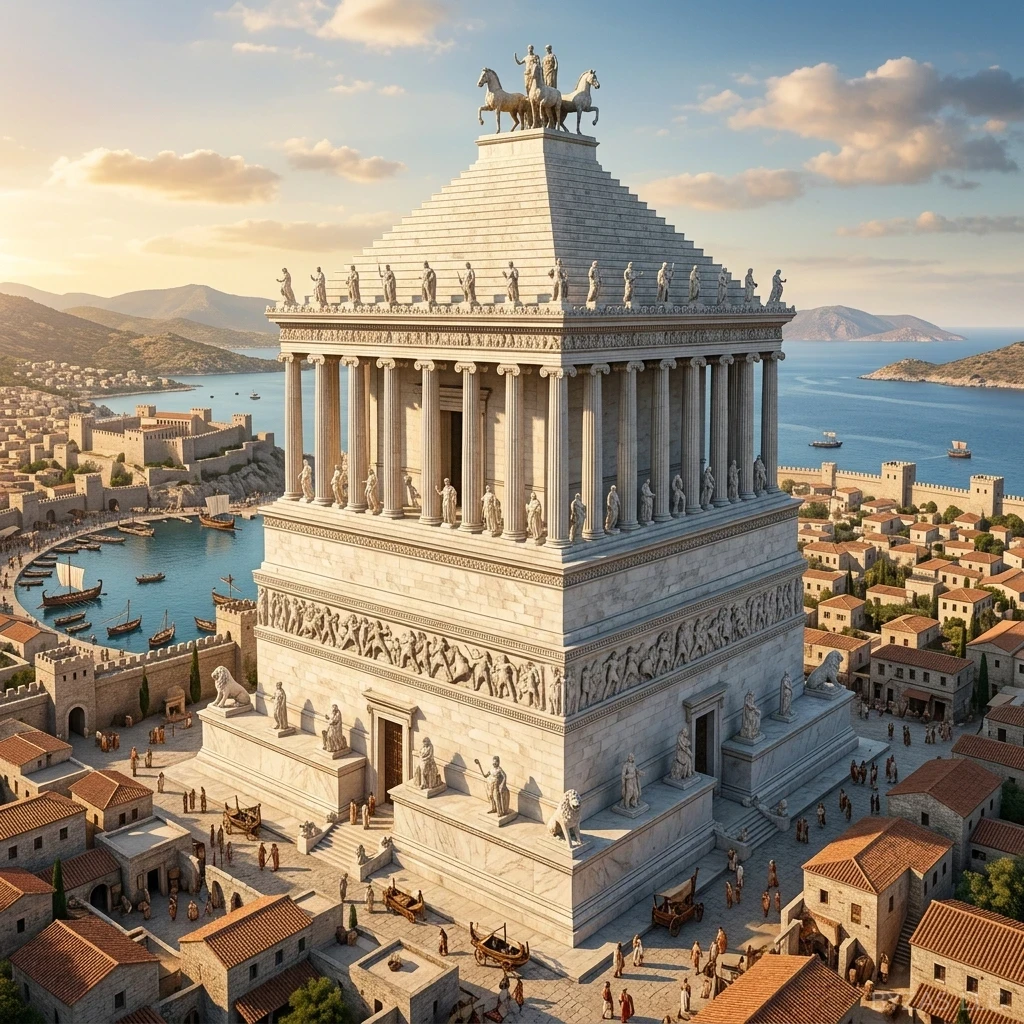
Maussollos designed Halicarnassus with theatrical geometry. Borrowing Hippodamian grid principles, he shaped the city like an ancient Greek theater, curving symmetrically around the horseshoe harbor. At the literal center of this architectural showpiece, he conceived his own eternal resting place — the Mausoleum.
Rising over 45 meters high, this monumental tomb combined three distinct architectural worlds: a heavy Egyptian pyramidal roof, a classical Greek Ionic colonnade, and an elevated Carian podium adorned with hundreds of life-sized relief sculptures carved by the absolute masters of the era, including Scopas and Leochares. The structure was so visually overwhelming that it broke the ancient vocabulary; from that moment on, any monumental tomb anywhere on earth would forever be called a mausoleum.
The Cradle of Western Historiography
Halicarnassus did not merely export architectural forms; it birthed the very framework through which humanity remembers itself. Around 484 BCE, Herodotus was born within these city walls. Dubbed the “Father of History” by Cicero, Herodotus broke away from the tradition of treating the past as a collection of divine myths or royal genealogies.
Instead, he initiated historía — systematic, empirical inquiry. By traveling extensively across Egypt, Persia, and the Aegean, interviewing local sources, and contrasting conflicting accounts of the Greco-Persian Wars, Herodotus laid down the foundational tenets of Western historical prose right here on these shores. The Bodrum Museum of Underwater Archaeology holds extensive contextual material on this ancient intellectual legacy.
The Long Sleep: Knights, Ottomans, and Sponge Divers
Following the destructive siege of Alexander the Great in 334 BCE, which crippled the city’s defensive infrastructure, Halicarnassus slipped into centuries of quiet decline. In 1402, the Knights Hospitaller of St. John arrived on the peninsula, seeking a naval stronghold against the expanding Ottoman Empire.
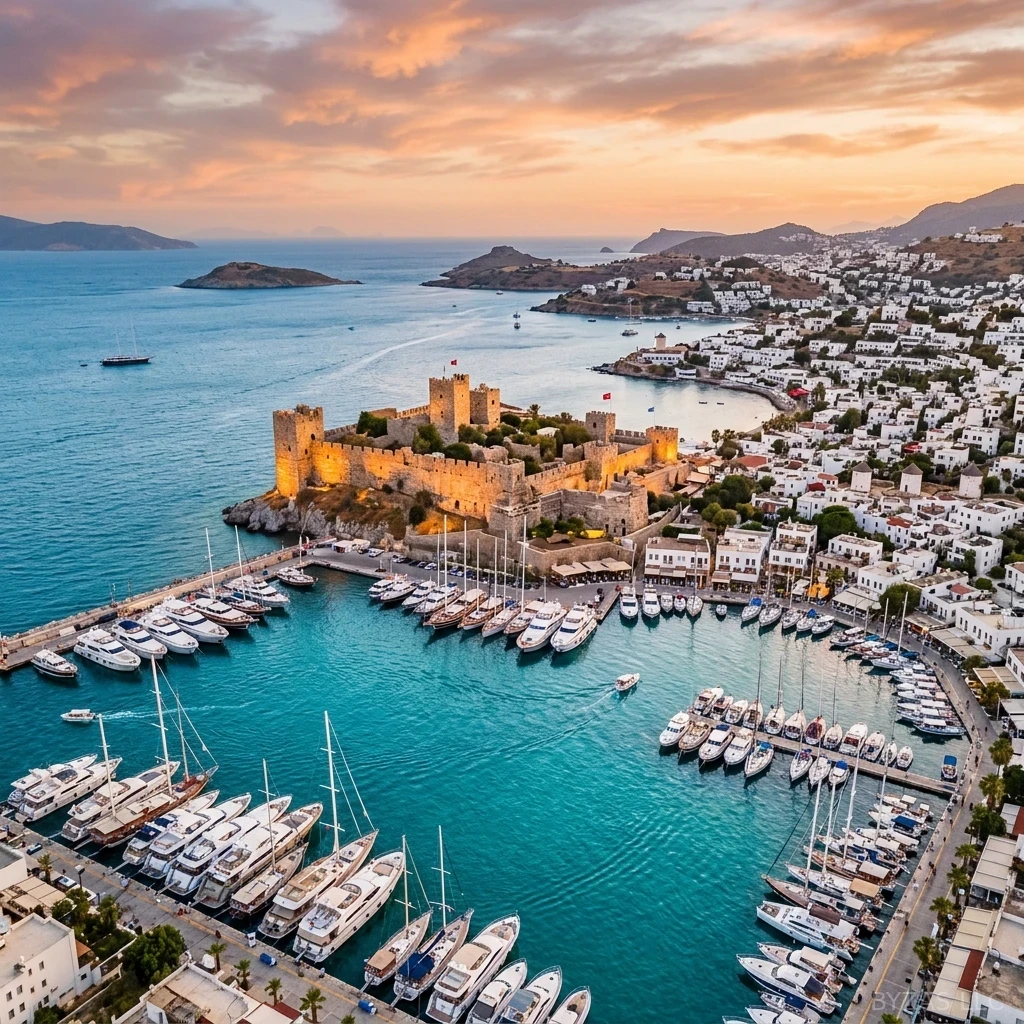
Using the collapsed marble blocks of the earthquake-shattered Mausoleum as raw quarry material, the Knights built the Castle of St. Peter — fortified with five distinct national towers (English, French, German, Italian, and Portuguese), a multilingual fortress that successfully repelled Ottoman forces until the fall of Rhodes in 1522.
Under Ottoman administration, Bodrum settled into a deeply isolated fishing village for four centuries. This long geopolitical slumber was a historical blessing in disguise; it insulated the peninsula from the industrial scars of the early 20th century, preserving the crystalline quality of its bays.
The primary local industry became one of extreme physical peril: sponge diving (sünger avcılığı). For generations, local captains and divers sailed traditional wooden boats out into the treacherous depths of the Aegean and North African coastlines, harvesting premium sea sponges. The immense psychological toll of this dangerous trade forged a community that was deeply resilient, intensely connected to the sea, and fiercely protective of their coastal solitude.
The Modern Renaissance: The Fisherman of Halicarnassus
The trajectory of modern Bodrum pivoted entirely in 1925, when a Turkish intellectual named Cevat Şakir Kabaağaçlı was sentenced to a three-year political exile in what was then considered the remote outpost of Bodrum. Rather than treating his exile as punishment, Cevat Şakir fell profoundly in love with the peninsula’s raw light, forgotten antiquities, and maritime solitude. Adopting the pen name The Fisherman of Halicarnassus (Halikarnas Balıkçısı), he began producing evocative essays and novels that romanticized the Aegean lifestyle.
Cevat Şakir, along with visiting cultural icons like Sabahattin Eyüboğlu and Azra Erhat, began chartering local wooden sponge-diving boats to explore the completely untouched coves of the Gulf of Gökova. These journeys birthed the concept of the Blue Voyage (Mavi Yolculuk) — a cultural movement that transformed the humble wooden working boat into a symbol of elevated bohemian escapism. By the late 1970s and 1980s, this intellectual trickle turned into an elite migration, as Istanbul’s artistic and industrial upper classes discovered Bodrum as the ultimate sanctuary for creative rejuvenation and high-discretion summering.
The Decadal Evolution: From Electricity-Less Outpost to Global High-Net-Worth Sanctuary
The transition from isolated fishing village to premium global asset was not an organic slow-growth model; it was a series of intense cultural and infrastructural leaps that completely reshaped an isolated peninsula.
The 1960s: The Pristine Isolated Outpost
In the 1960s, Bodrum was, for all practical purposes, an island. Highway infrastructure from Izmir or Milas was virtually non-existent — dirt tracks that became impassable mud during winter rains. There was no centralized electricity grid; local homes relied on kerosene lamps. The economy was transitioning away from deep-sea sponge diving, following a devastating marine disease that wiped out local sponge populations in the early 1960s.
It was during this decade of raw isolation that the first wave of elite Turkish artists and visionary architects — inspired by Cevat Şakir — began purchasing ruined stone houses in the central harbor for negligible amounts, establishing an unwritten code of architectural preservation and intellectual freedom.
The 1970s: The Bohemian Modern Seeding
The 1970s marked the birth of institutionalized bohemian tourism, and the codification of Bodrum’s iconic white-cube architectural identity. Under the strict guidance of visionary local figures, the municipality implemented rigorous building regulations: no structure could rise above two stories, all buildings had to be finished in local white lime plaster, and traditional stone accents were mandatory. This brilliant legal intervention single-handedly saved Bodrum from the catastrophic high-rise mass tourism that destroyed other Mediterranean coastlines during the same era.
The 1980s: The Infrastructural Pivot
The economic liberalization reforms of Prime Minister Turgut Özal connected Turkey directly to global financial markets. For Bodrum, this meant the arrival of the national electricity grid, the first true asphalt roads connecting the isolated northern bays of Yalıkavak, Göltürkbükü, and Gümüşlük, and the opening of the first upscale boutique hotels. The central harbor became lined with sophisticated bars and jazz clubs, transforming Bodrum from an exclusive intellectual hideaway into the definitive summer capital for Turkey’s industrial tycoons.
The 1990s: The Mega-Yacht and Airport Catalyst
The absolute turning point occurred in 1997 with the operational opening of Milas-Bodrum Airport (BJV). Prior to this, international travelers endured a grueling 4-hour drive from Izmir Airport. BJV cut transit time to 45 minutes, placing Bodrum within a direct 3-hour flight window from major European capitals. Simultaneously, the global superyacht community discovered the pristine deep-water qualities of the peninsula’s northern bays, beginning to pull luxury vessel traffic away from Saint-Tropez, Monaco, and Porto Cervo.
The 2000s to 2010s: The Institutional Luxury Invasion
With international accessibility secured, the world’s most elite hospitality brands executed a coordinated entry onto the peninsula. The arrival of properties like the Amanruya — an ultra-exclusive Aman resort tucked into the pine forests of Torba — and later the Mandarin Oriental in Paradise Bay fundamentally upscaled the luxury baseline. Yalıkavak transitioned permanently into its mega-yacht identity, opening a state-of-the-art superyacht marina to accommodate hulls over 100 meters.
The 2026 Reality: The Sovereign Discretion Paradigm
Today, Bodrum has entered its ultimate philosophical maturity. The market has moved entirely beyond loud, high-visibility consumerism. The contemporary global traveler demands absolute spatial security, localized authenticity, and uncompromising service fluidity. Luxury is no longer defined by massive logos or overcrowded beach clubs; it is an architecture of entirely personalized, isolated experiences.
The Peninsula Anatomy: Neighborhood Transformations & Geographic Evolution
The Bodrum peninsula is not a singular destination, but an intricate archipelago of micro-cultures, each occupying its own volcanic bay and possessing a highly distinct socioeconomic profile.
Yalıkavak: From Sponge Outpost to Global Mega-Yacht Epicenter
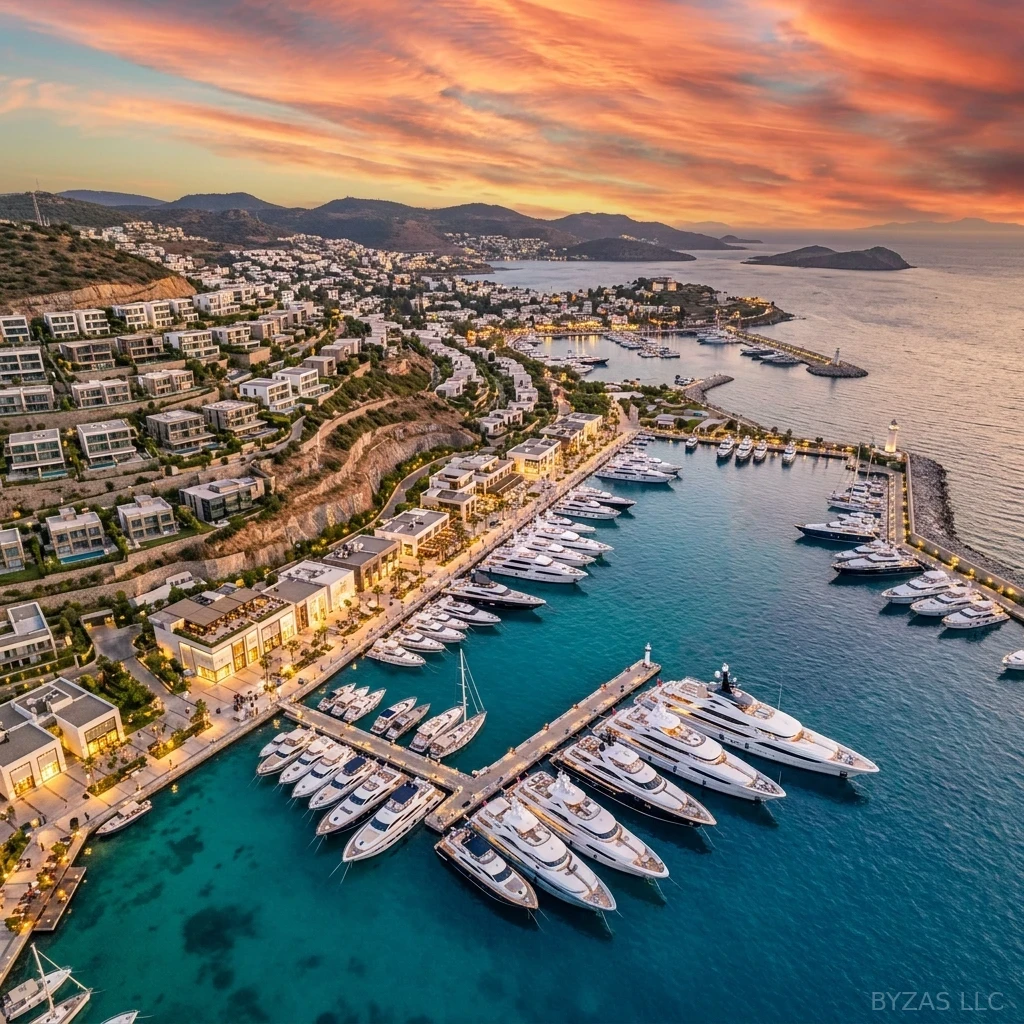
Positioned on the windswept northwestern tip of the peninsula, Yalıkavak was historically a harsh, isolated working town dependent entirely on sponge diving and wind-powered grain milling. The turning point came with the engineering of its natural deep-water bay to build Yalıkavak Marina — a development that fundamentally altered the luxury map of the eastern Mediterranean by offering berths capable of hosting superyachts and mega-yachts up to 120 meters in length.
Today, the traditional stone village structure exists in direct parallel with an ultra-exclusive luxury shopping avenue featuring global haute couture houses, open-air art installations, and elite fine dining. The hillsides above the marina are dominated by minimalist glass-and-stone architectural estates that fetch multi-million euro valuations for their dramatic sunset vistas over the Aegean archipelago.
Göltürkbükü: The Birthplace of High-Discretion Coastal Glamour
Formed by the administrative merging of two distinct rural settlements — Gölköy, a lush agricultural valley rich in freshwater springs, and Türkbükü, a rocky, protected fishing cove — Göltürkbükü represents the absolute peak of established Turkish old-money summering.
During the late 1990s and early 2000s, Türkbükü pioneered the high-end beach lounge concept in Turkey, transforming simple overwater wooden docks used by fishermen into highly exclusive daytime sundecks. Because the geography lacks natural sandy beaches, overwater piers became the default architectural form for luxury sunbathing and high-society visibility.
Göltürkbükü operates with strict environmental and social insulation — a car-free, pedestrianized waterfront ecosystem where luxury boutique hotels operate behind heavy botanical screens of bougainvillea and olive trees. It remains a sanctuary where captains of industry, global tech founders, and media barons can walk the wooden boardwalks with absolute anonymity.
Gümüşlük: The Bohemian Preservation of Ancient Myndos
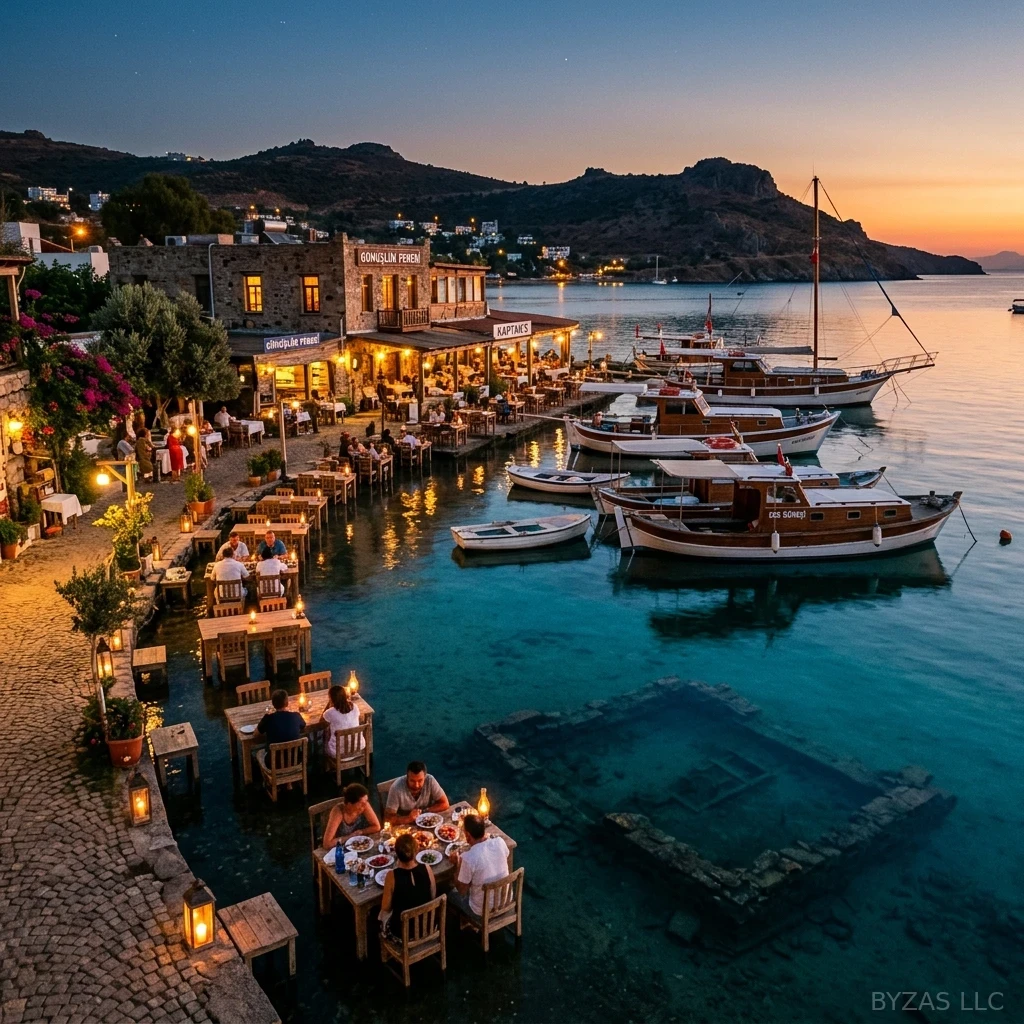
On the westernmost point of the peninsula lies Gümüşlük, a village built directly on top of the ancient Lelegian and Roman port city of Myndos. During late antiquity, a massive portion of the ancient city’s harbor walls slipped beneath the surface of the sea, creating the famous “Sunken City” (Batık Şehir). Because of this profound underwater archaeological footprint, Gümüşlük was placed under strict Type-1 Archaeological Preservation Status — an absolute building ban that prevented the construction of mega-resorts or wide highways.
Consequently, Gümüşlük evolved into a deeply artistic, bohemian enclave. Its narrow, unpaved coastal track is lined with rustic stone fish taverns where tables are set directly in the shallow, glassy water. It attracts independent classical musicians, painters, and literary figures who gather for the annual International Gümüşlük Music Festival, making it the intellectual counterweight to the high-gloss luxury of Yalıkavak.
Torba: The Modern Gateway to New-Age Luxury Enclaves
Torba sits on the northeastern neck of the peninsula, tucked into a deep, pine-clad bay facing the Gulf of Güllük. The contemporary era has chosen Torba as the canvas for a brand-new expression of ultra-luxury, redefined by monumental, architecturally avant-garde resort complexes that integrate private peninsula enclaves with global gastronomic brands. Torba’s proximity to the main highway makes it the ideal base for elite travelers who require rapid, fluid transit between their private retreats and the mega-yacht hubs of the west coast.
Bitez and Ortakent: The Citrus Groves and Fertile Plains
Bitez and Ortakent occupy the fertile southern valley plains of the peninsula — the agricultural engine of Bodrum, historically covered in incredibly fragrant mandarin orchards (Bodrum mandalini). The unique stone tower-houses (Bodrum kule evleri) found here were originally built in the 17th and 18th centuries as fortified agrarian estates. While the coastal strips have evolved into premier windsurfing and sailing hubs due to reliable thermal wind patterns, the interior valley floors have transformed into highly sought-after residential sanctuaries where century-old stone farmhouse estates appeal to creative elites who value agricultural solitude over waterfront visibility.
Yalıçiftlik: The Untouched Wilderness Frontier
Located on the isolated southeastern base of the peninsula, where rugged mountains meet the Gulf of Gökova, Yalıçiftlik remains the most geographically protected and naturally raw territory on the peninsula. Free from high-density commercial centers, its landscape is defined by sheer cliffs, ancient pine forests, and dramatic deep-blue waters. Yalıçiftlik is the choice destination for ultra-private wellness retreats, eco-luxury resorts, and massive, completely secluded private estates owned by global royals and old-world industrial dynasties.
The 2026 Master Map: High-End Beach Clubs & Sensory Dining
The contemporary 2026 summer season has ushered in an era of unprecedented gastronomic sophistication. The trend has shifted entirely away from generic luxury templates toward highly tailored sensory ecosystems — where world-renowned culinary direction, bespoke architectural lighting, and precise acoustic curation converge.
The Maxx Royal Gastronomy Center (Torba)
Leña — Conceived by the three-Michelin-starred Spanish culinary icon Dani García, Leña is a masterclass in wood-fire gastronomy. The architecture utilizes raw timber and textured stone, creating an organic frame for a menu centered on open-flame cooking. Signature offerings include masterfully dry-aged Tomahawk steaks, whole roasted Andalusian daily catches, and smoked charcoal vegetables that elevate rustic fire techniques into fine art.
Spago Terrace — Perched on a dramatic rooftop elevation, Wolfgang Puck’s signature concept commands uninterrupted views of the Torba horizon. The 2026 iteration operates with a highly fluid lounge-to-dining transition, pairing artisanal wood-infused cocktails with Puck’s legendary spicy tuna tartare cones and elevated seasonal sushi platters.
Casa Sol — This beachfront concept introduces a highly curated Latin American narrative to the Aegean. Operating as a low-slung, bohemian day-lounge that sharpens into a high-octane dinner venue, its menu highlights pristine ceviches, slow-cooked wagyu barbacoa, and an exhaustive mezcal cellar managed by dedicated agave sommeliers.
The Luxury Dining Scene at Mandarin Oriental (Paradise Bay)
Maison Revka — Developed by the elite French hospitality group Paris Society, Maison Revka brings an extraordinary blend of Parisian luxury and Slavic opulence to the Aegean waterfront. The decor features plush fabrics, vintage crystal chandeliers hanging from open-air pergolas, and manicured summer gardens. The menu focuses on the absolute highest tier of indulgence: signature caviar arrays, cold-smoked salmon, beef stroganoff executed with wagyu tenderloin, and delicate sculptural pavlovas.
GAIA — Infusing a vibrant Greek-Mediterranean spirit into the Turkish coastline, GAIA focuses on pristine wild-caught fish, raw seafood bars, and cold-pressed local olive oils served under a canopy of ancient olive trees.
ROKA & Hakkasan — These two global powerhouses remain central pillars of the Paradise Bay evening ritual. ROKA commands the night with its centralized, high-energy Japanese Robatayaki charcoal-grill theater, while Hakkasan offers its world-famous modern Cantonese culinary art accompanied by sleek, bass-heavy acoustic design.
Elite Independent Beach Clubs & Cultural Hideaways
Scorpios Bodrum — Situated on its own isolated headland, Scorpios remains the definitive epicentre of the global creative and entrepreneurial elite. It merges holistic morning wellness programs with deep, avant-garde ethno-house sunset rituals.
The Beach of MOMO (Yalıkavak) & Lucca Beach (Göltürkbükü) — These two venues represent the absolute pinnacle of high-energy daytime luxury lifestyle, catering to a discerning crowd with hyper-creative mixology programs and a seamless transition from afternoon sunbathing to open-air sunset dance rituals.
Ufak Grillery (Bitez) — Positioned inside a deeply private, old-stone walled courtyard in the historic center of Bitez, this sophisticated independent venture rejects the high-volume flash of the mega-resorts in favor of an uncompromisingly minimalist charcoal-grill menu paired with a strictly curated acoustic backdrop of modern UK rap, deep house, and Japanese ambient sets.
Architectural Icons & Hidden Wonders: The Imperative Itinerary
The Castle of St. Peter and the Museum of Underwater Archaeology
Dominating the central harbor grid, this 15th-century fortress is one of the world’s most vital repositories of maritime history. The structural layout requires active exploration, with stone staircases ascending into specialized exhibition halls that house ancient shipwrecks recovered by international marine archaeologists.
The Uluburun Shipwreck Hall — This exhibit holds the remains of a Late Bronze Age vessel dating back to the 14th century BCE, discovered off the coast of Kaş. It is the oldest excavated seagoing hull ever discovered. The display features an astonishing cargo of raw copper ingots, Canaanite amphorae, Baltic amber beads, and the legendary solid gold scarab of Egyptian Queen Nefertiti.
The Glass Hall — This space showcases over a thousand pieces of ancient glass artifacts, recovered primarily from the Serçe Limanı Byzantine shipwreck. Specialized fiber-optic lighting inside the dark stone vaulted hall allows visitors to witness the exquisite preservation of glass vessels that spent over a millennium on the ocean floor.
Insider Tip: To experience the castle without the heavy mid-day summer crowds, arrive precisely at 08:30 AM. Secure access to the North Tower first; its elevated crenellations offer a superior architectural perspective over the twin harbors before the daily charter fleet departs.
Pedasa: The Forgotten Lelegian Capital
Hidden within dense pine forests and ancient olive terraces on the hills directly above central Bodrum lies Pedasa — of all eight indigenous Lelegian cities on the peninsula, the most structurally intact. Visitors can trace monumental dry-stone city walls and explore unique corbelled stone tumulus tombs dating back to the Geometric Period. The site is a profound study in defensive urban planning, completely untouched by modern commercial infrastructure.
Access Protocol: Best approached in the early morning via a mild trek through the signposted pine tracks starting from the upper ridges of Konacık. Wear heavy terrain boots; the ancient stone pathways are uneven and entirely unpolished.
Karakaya Köyü: The 800-Year-Old Pirate Refuge
Tucked into a jagged volcanic cleft on the high ridges overlooking Gümüşlük, Karakaya is a ghost village built in the 14th century. The village was intentionally positioned away from the coastline, camouflaged by local gray stone to remain completely invisible from the sea as a defense against raiding Aegean pirates. Walking through the narrow, overgrown paths provides an intensely atmospheric window into the deep architectural survival tactics of the medieval peninsula.
2026 Seasonal Weather & Microclimate Dynamics
The meteorological profile of the Bodrum peninsula is classically Mediterranean, yet profoundly modified by its unique peninsular orientation jutting deep into the Aegean Sea. For the 2026 summer season, peak daytime temperatures in July and August average between 34°C and 36°C (93°F – 97°F).
The defining natural luxury of Bodrum’s climate is the Meltemi wind (referred to locally as the Etezyen). This predictable, dry seasonal northerly wind system activates consistently around mid-morning, reaches its peak velocity in the mid-afternoon, and dissipates entirely at sunset — dropping relative humidity across the peninsula significantly and creating an exceptionally high bioclimatic comfort index.
The Micro-Climatic Divide
- The North Coast (Yalıkavak, Gündoğan, Göltürkbükü): Receives the direct impact of the Meltemi. Water temperatures here remain slightly cooler and crisper, with air constantly in motion — highly desirable during peak heat waves.
- The South Coast (Bitez, Ortakent, Bodrum Merkez): Topographically protected by the central mountain spine. Waters here are remarkably calm, flat, and mirror-like — premier moorings for yachts, though the air feels perceptibly warmer.
Logistics & Seamless Travel: The Transportation Architecture
Navigating the Bodrum peninsula smoothly requires a sophisticated understanding of its complex, winding geography. The region is expansive, mountainous, and deeply fragmented into isolated bays. While distances appear short on a linear map, the reality of navigating coastal switchbacks, seasonal traffic congestion, and strict parking restrictions can introduce significant friction to an uncoordinated itinerary.
Arriving via Milas-Bodrum Airport (BJV)
Milas-Bodrum Airport sits roughly 45 kilometers northeast of Bodrum center. A direct transit to the central harbor takes approximately 45 minutes, while reaching the outer luxury enclaves of Yalıkavak or Göltürkbükü easily spans 60 to 75 minutes during peak afternoon transit hours.
While public shuttle networks like Havaş and MUTTAŞ run scheduled routes from the terminals to the central Bodrum bus station, they do not service private villa zones, exclusive marinas, or high-end resorts. Relying on standard local airport taxis introduces communication barriers, variable vehicle qualities, and unnecessary logistical delays.
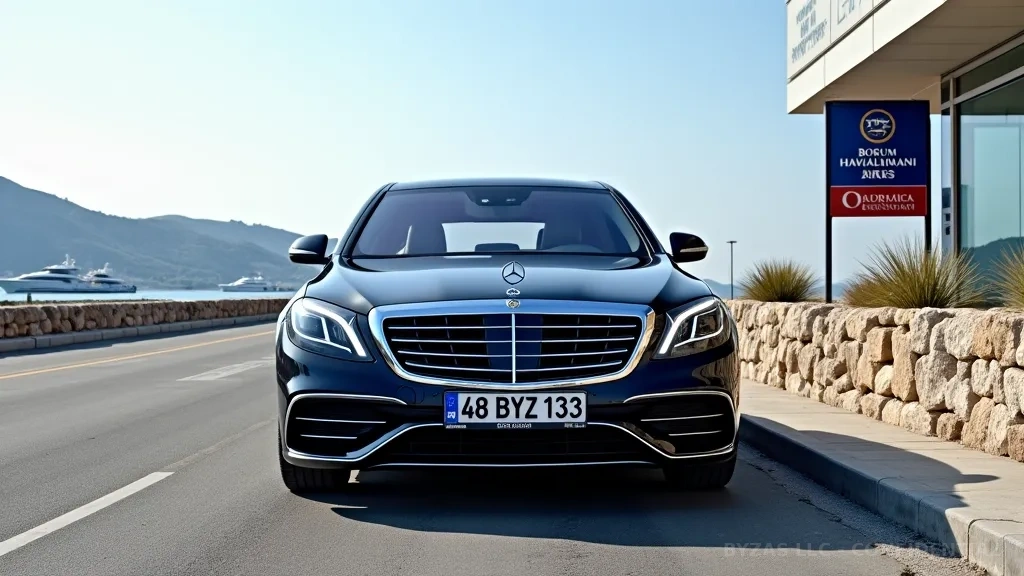
To achieve an absolute frictionless transition from air to coast, arranging a premier Bodrum luxury transfer prior to arrival is considered the operational standard among UHNWI travelers. A professional, pre-booked chauffeur who monitors your flight telemetry ensures an immediate terminal exit to a pristine, climate-controlled executive vehicle, completely bypassing the heat and queues of the public arrival gates.
| Destination Bay | Approx. Transit Time | Recommended Routing |
|---|---|---|
| Torba / Milta | 40 – 45 Minutes | D330 Highway (Direct) |
| Göltürkbükü | 55 – 60 Minutes | Torba-Gölköy Coastal Road |
| Yalıkavak Marina | 65 – 75 Minutes | Gündoğan Pass or Central Cross |
Peninsula Mobility: The Chauffeur Mandate
Once established at a resort or private villa estate, traveling between distinct bays for fine dining or beach clubs poses a distinct logistical challenge. The roads connecting the northern and southern arms of the peninsula are steep, single-lane mountain routes with sharp turns and minimal lighting at night. Parking at premium destinations like Yalıkavak Marina or central Göltürkbükü during July and August is notoriously difficult, with valet wait times often exceeding 45 minutes.
Utilizing a dedicated Bodrum chauffeur service completely transforms the operational flow of your stay. A private driver provides absolute scheduling freedom, allowing you to move spontaneously between remote archaeological sites and seaside dinner venues — your vehicle remains permanently on standby, enabling you to step directly from a beach club sunset into a cooled cabin without a single moment of logistical coordination.
Discretion and Security Protocols
Given Bodrum’s status as a high-visibility summer hub for global tech founders, corporate executives, and high-net-worth families, managing privacy and public interaction is a frequent operational necessity. The intense concentration of wealth and media attention around the primary marinas and festival venues demands a subtle, highly professional approach to personal safety.
Implementing a tailored executive protection framework allows high-profile travelers to navigate public events, large-scale festivals, and high-density luxury zones with absolute confidence. Professionally trained close protection personnel operate in seamless harmony with your chauffeur team, conducting advanced route reconnaissance, managing secure venue access points, and maintaining an inconspicuous protective perimeter that ensures your entire itinerary remains safe, private, and entirely relaxed.
Curated 2026 Summer Event Calendar
Bodrum’s cultural programming has evolved into a sophisticated blend of international music festivals, maritime traditions, and performing arts.
-
Candyland Summer Fest (Torba): Operating out of an immersive production venue in Torba, this festival merges magnificent daytime carnival parades, interactive design workshops, and massive evening mainstage performances. High-profile acts including Lvbel C5 are booked for highly anticipated sets in early August 2026. Entry tier ticketing begins at 4,000 TL, with private VIP bento stages and private lounges available through direct booking.
-
International Gümüşlük Music Festival (July – September 2026): Set against the backdrop of a 2,500-year-old ancient stone quarry and the historic waterfront, this long-running festival brings world-renowned classical pianists, virtuoso cellists, and international jazz ensembles for candlelit evening performances.
-
International Bodrum Ballet Festival (Late July – August 2026): Staged inside the majestic northern courtyard of Bodrum Castle, this event features premier national and international ballet companies performing classical and contemporary masterpieces under the stars.
-
The Bodrum Cup (October 18 – 25, 2026): This internationally acclaimed superyacht and traditional wooden gulet regatta transforms the peninsula into a spectacular floating festival in early autumn, marking the grand finale of the sailing season and drawing elite racing teams from across the globe.
Practical Information for the Discerning Traveler
Private Villa Communities vs. Ultra-Luxury Resorts: While Bodrum offers world-class five-star resort brands, the international elite heavily favor the peninsula’s exclusive private villa communities. Enclaves tucked into the high ridges above Yalıkavak, the isolated cliff faces of Türkbükü, or the quiet valleys of Turgutreis offer sprawling architectural footprints that fuse raw local stone with dramatic glass facades, complete visual isolation, private infinity pools, dedicated staff quarters, and independent helipads.
The Fine Dining Reservation Protocol: The reservation ecosystem in Bodrum during peak summer operates with extreme competitive density. For premium venues such as Leña, Maison Revka, Spago, and Scorpios, reservation logs for prime sunset tables are routinely locked weeks in advance. Walk-in availability is practically non-existent. Delegate your dining calendar to your luxury travel advisor or estate concierge a minimum of 20 days prior to arrival.
Currency, Banking, and Language Dynamics: The official currency is the Turkish Lira (TL). Payment systems across all major luxury resorts, marinas, and high-end restaurants accept all major international corporate credit cards. While English is spoken with absolute fluency within the luxury hospitality network, stepping outside this bubble — visiting independent artisan studios in Dereköy or interacting with vendors at the Yalıkavak farmers’ market — will bring you into contact with locals who speak exclusively Turkish.
Experiencing Bodrum Like a True Insider
To unlock the genuine, poetic soul of the peninsula requires a deliberate departure from high-visibility commercial zones.
The Custom Gulet Expedition: Avoid the commercial day boats completely. Instead, coordinate a private, multi-day voyage on a custom-designed wooden gulet — the traditional double-masted sailing vessels born from Bodrum’s historic shipyards. Instruct your captain to navigate deep into the Gulf of Gökova, dropping anchor in completely unpopulated wilderness coves like Orak Island or Seven Islands, where you can swim in waters of absolute crystalline clarity and dine on caught-to-order seafood prepared by a private onboard chef.
The Interior Artisan Routes: Dedicate a morning to exploring the rural interior valley villages of Milas, Mumcular, and Dereköy. Meet directly with independent local ceramicists, master glassblowers, and heritage carpet weavers who maintain private studios within ancient olive groves. Acquiring museum-grade works directly from these creators offers a profound level of cultural connection completely unavailable in commercial galleries.
The Midnight Sea Ritual: One of the most cherished, undocumented local traditions is the late-night swim under a full moon. The waters of the southern bays — Bitez or Akvaryum Bay — become perfectly flat, warm, and mirror-like after midnight once the Meltemi wind has been asleep for hours. Swimming in this silent, ink-blue water under the glow of the Aegean sky is a deeply meditative experience that captures the timeless spirit of the peninsula.
Bodrum rewards those who approach its shores with patience, respect for its deep historical layers, and a commitment to flawless logistical execution. By effortlessly bridging 2,500 years of profound maritime civilization with the absolute height of contemporary Mediterranean luxury, it remains an unmatched, permanently alluring sanctuary for the world’s most discerning travelers.