COP31 Antalya 2026 Executive Travel and Ground Logistics
Executive Summary
The 31st Conference of the Parties to the United Nations Framework Convention on Climate Change (COP31) convenes in Antalya, Turkey, from November 9 to November 20, 2026. The Antalya Expo Center (ANFAŞ) will host heads of state, diplomatic missions, ministerial delegations, and ultra-high-net-worth individuals (UHNWIs) across a 12-day operational window. Ground logistics for this event demand a level of operational precision that standard transport providers cannot deliver.
This briefing establishes the authoritative operational parameters for protocol officers, executive assistants, and family office managers responsible for delegating ground movement during the summit. All information reflects documented BYZAS operational experience in comparable high-security conference environments in Turkey.
Operational Parameters
Conference Timeline and Site Overview
COP31 operates under a compressed, programmatically rigid schedule. Each day contains a morning plenary session (09:00-12:00), afternoon working group meetings (14:00-17:00), and evening bilateral or social events (19:00-22:00). This structure creates three distinct surge windows for ground transportation demand, each requiring simultaneous multi-vehicle deployment across hotel-to-venue corridors.
The Antalya Expo Center (ANFAŞ) occupies a purpose-built conference campus in the Kaslı region, approximately 25 kilometers east of Antalya Airport (AYT). The site is flanked by two primary hotel clusters: the Lara Beach corridor (west, 15-20 minutes from venue) and the Kundu/Belek corridor (north, 25-35 minutes from venue). Delegations operating from Istanbul or Bodrum pre-conference will route through Istanbul Atatürk (ISL) or Bodrum Milas-Bodrum (BJV) private aviation terminals.
Antalya Airport (AYT) will manage a projected 340% increase in private aviation movements during the conference period compared to baseline November traffic. Private jet apron capacity at AYT is finite. Without pre-positioned ground assets and coordinated apron access, principals face surface transport delays of 45 to 90 minutes upon landing.
Apron and Tarmac Access Protocol
Pre-Positioning Requirements
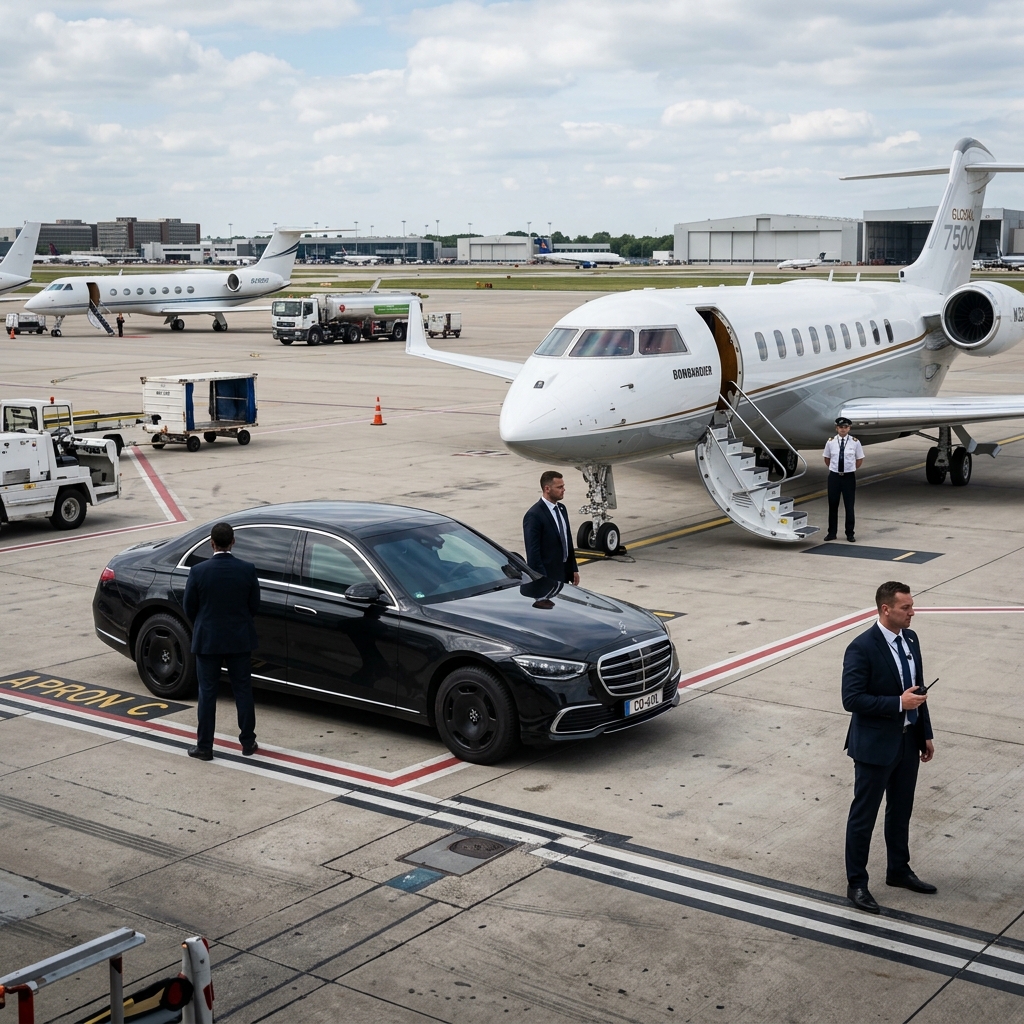
Direct tarmac access at AYT for private aircraft requires advance coordination with DHMI (State Airports Authority) and the local air traffic control authority. BYZAS operations maintain standing operational relationships with AYT apron control that allow vehicle staging on the active tarmac adjacent to arriving private aircraft.
Pre-positioning logistics for COP31 involve three sequential stages:
Stage 1 — 72 Hours Prior: Advance reconnaissance vehicle deploys to AYT to confirm apron allocation, identify security checkpoint entry points, and coordinate with aviation fuel and ground handling providers. This vehicle also confirms the principal’s flight schedule and tail number with AYT operations.
Stage 2 — 24 Hours Prior: The primary B6-armored convoy stages at AYT private aviation terminal. Vehicles are positioned in designated apron bays no more than 60 meters from the aircraft parking stand. Chauffeurs complete security credential verification with local police and UN security liaison. Vehicle inspection (undercarriage, interior, trunk) is conducted on-site.
Stage 3 — Tarmac Operation: Upon aircraft arrival, the principal exits via mobile stairs directly to the climate-controlled vehicle interior. The target transfer window from aircraft door to vehicle seat is under 30 seconds. Luggage is handled simultaneously by a secondary advance vehicle, eliminating any wait time for cargo processing.
Apron Access Credentials
Access to the AYT private aviation apron during COP31 requires:
- DHMI-issued apron access badge (pre-applied, non-transferable)
- UN COP31 vehicle accreditation sticker (displayed on windshield and rear quarter panels)
- Driver’s license scanned and uploaded to the UN Blue Zone credentialing portal 14 days in advance
- Vehicle registration documents in the name of the accredited transport provider
All BYZAS vehicles assigned to COP31 operations carry these credentials as standard procedure. No exceptions are made for late-stage bookings.
Armored Fleet Specifications
B6-Armored Mercedes S-Class
The Mercedes S-Class with B6 (VPAM BRV2006) armoring is the primary principal transport vehicle for COP31 operations. The following specifications represent the certified operational standard BYZAS maintains in its Turkey-based fleet:
| Specification | Detail |
|---|---|
| Armor Level | B6 / VPAM BRV 2006 — Ballistic and blast protection |
| Ballistic Resistance | 7.62x51mm NATO ball, 5.56x45mm NATO, 9mm Parabellum |
| Floor Armor | Simultaneous detonation resistance for two DM51 hand grenades |
| Run-Flat System | Run-flat tires maintaining 50 km/h for 50 kilometers post-puncture |
| Oxygen System | Independent self-contained oxygen supply (gas attack mitigation) |
| Glass Thickness | Minimum 39mm multi-layered bullet-resistant polycarbonate glass |
| Engine | 4.0L biturbo — armored door and pillar reinforcement |
| Seating Capacity | 4 passengers + 1 chauffeur (rear executive configuration) |
| Communication | Built-in encrypted intercom between passenger compartment and escort vehicles |
Support Fleet Configuration
COP31 motorcade operations require layered vehicle deployment. The standard configuration consists of:
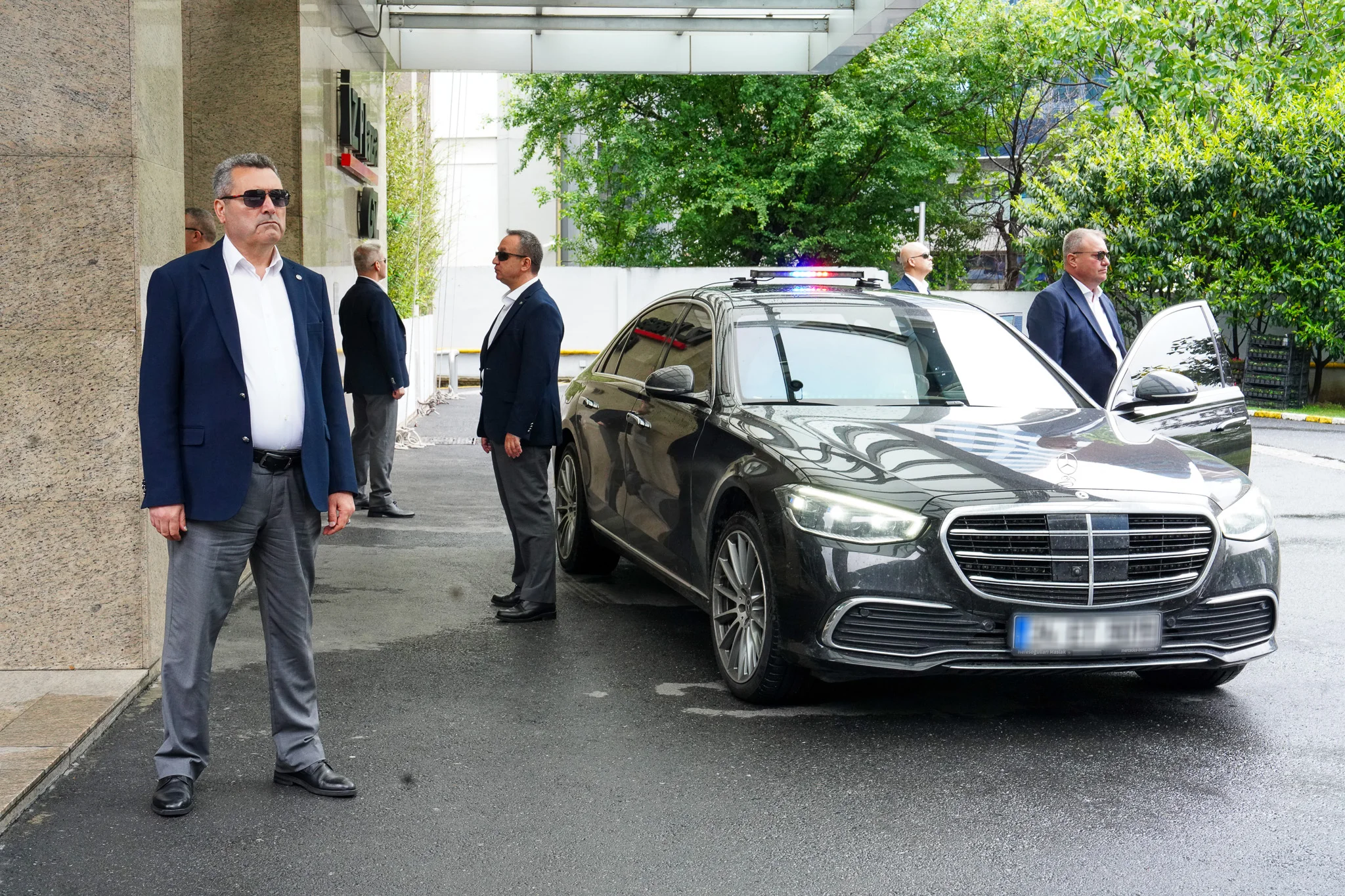
Lead Security Vehicle: Mercedes G-Class (armored) with two close protection officers. This vehicle conducts advance sweep of the route and establishes the primary convoy pace.
Principal Vehicle: B6-armored Mercedes S-Class. Always preceded by the lead vehicle and followed by a third vehicle carrying additional security personnel and technical support.
Luggage and Equipment Vehicle: Mercedes V-Class (armored or unarmored depending on threat assessment). This vehicle carries principal luggage, medical kit, communications equipment, and any diplomatic pouches.
Decoy Lead Vehicle: Identical configuration to the principal vehicle (same model, same color). Deploys on a secondary route simultaneously to obscure the principal’s actual movement.
Convoy Operations and Route Security
Convoy Formation
Multi-vehicle convoy operations for COP31 ministerial delegations follow a rigid formation protocol:
- Lead security vehicle departs first (T-5 minutes)
- Decoy lead vehicle departs simultaneously on the secondary route (T-5 minutes)
- Principal vehicle departs from hotel/AYT apron (T-0)
- Support/luggage vehicle follows at 30-second interval (T+30 seconds)
- Close protection officers in trailing vehicle complete the convoy (T+60 seconds)
This staggered departure protocol ensures that at no point are all vehicles visible at the same location, reducing the effectiveness of hostile surveillance.
Route Security Layers
Route selection for COP31 movements operates on a three-tier priority system:
Primary Route: Highway D-400 corridor (Antalya-Kaslı). Primary route for all movements. Pre-swept 90 minutes before departure.
Secondary Route: Provincial road 635 through the Altınkaya junction. Activated if primary route is compromised or if threat intelligence indicates elevated risk on the primary corridor.
Tertiary Route: Rural road network through the Döşemealtı plateau. Emergency extraction route, used only in the event of a security incident requiring complete route deviation.
All three routes are physically reconnoitered by BYZAS advance teams 72 hours before each movement. Construction, road closures, and unauthorized gatherings are reported to the operations desk and logged in the movement manifest.
UN Blue Zone Access
The UN Blue Zone at the Antalya Expo Center operates under strict perimeter security. Vehicle entry requires:
- UN-issued vehicle pass (displayed on front windshield)
- Valid driver accreditation (pre-registered with UN security)
- Vehicle inspection at the perimeter checkpoint (undercarriage scan, document check)
- Passenger identity verification against the conference registration database
BYZAS vehicles and drivers are pre-cleared through the UN credentialing system. Principals transferred to BYZAS vehicles at the Blue Zone perimeter do not need to undergo secondary identity verification for the return journey, provided the vehicle credential remains valid.
Delegation Transfer Protocols
Ministerial-Level Delegations
For ministerial delegations requiring motorcade integration with official Turkish National Police escorts, BYZAS coordinates directly with the Antalya Provincial Security Directorate. The integration protocol requires:
- Advance notice of 7 days for police escort allocation
- Vehicle manifest submission (plate numbers, vehicle models, passenger names)
- Lead police vehicle identification and radio frequency coordination
- Designated rally points in the event of convoy separation
Police escort integration is most commonly required for delegations traveling from AYT to the Lara Beach hotel cluster, where the D-400 highway crossing creates a convergence point with the police-led VIP corridor.
Multi-City Pre-Conference Logistics
Delegations arriving in Turkey prior to COP31 frequently conduct preliminary meetings in Istanbul or Ankara before routing to Antalya. BYZAS maintains dedicated fleet assets in both cities for this purpose.
The standard pre-conference routing sequence:
- Istanbul (ISL/SAW): Principal arrives Istanbul. B6-armored vehicle staging at Atatürk or Sabiha Gökçen private aviation terminal. Istanbul hotel-to-Embassy/Consulate movements handled during Day 1-3.
- Ankara (ESB): Principal transits to Ankara for diplomatic meetings at the Çankaya district. Ground logistics for Ankara leg handled by BYZAS Ankara protocol team. Vehicle change-over occurs at Esenboğa Airport private aviation apron.
- Antalya (AYT): Principal arrives Antalya for COP31. Full tarmac protocol activated (see Section 2 above).
This three-city sequencing requires asset pre-positioning 5 days in advance of the principal’s arrival in Turkey. Late-stage bookings (within 72 hours of arrival) cannot guarantee vehicle availability in all three cities simultaneously.
Ground Logistics for Private Aviation Crew
Beyond principal transport, COP31 generates significant demand for private aviation crew ground logistics. Flight crew arriving on private aircraft require dedicated crew transport separate from passenger movements.
Crew ground logistics requirements at AYT during COP31:
- Crew transport vehicles must be positioned on the apron within 15 minutes of aircraft parking
- Crew rest facilities at the Kundu hotel cluster require pre-arranged accommodation credentials
- Crew movement between AYT and the Antalya city center (for crew rest breaks) requires dedicated vehicles separate from principal transport assets
- Crew visa and accreditation support is coordinated through BYZAS Istanbul operations desk
BYZAS maintains a dedicated crew transport fleet at AYT during COP31, comprising Mercedes V-Class vehicles with luggage capacity for 6 crew members plus equipment.
Fleet Allocation and Booking Timeline
The B6-armored fleet available for COP31 is finite. Turkey-based B6-armored vehicle availability outside of Istanbul is limited to 12 units during the conference period. Security-cleared chauffeurs with UN Blue Zone accreditation number fewer than 30 in the BYZAS Turkey network.
Booking deadline: All COP31 allocations must be confirmed by October 15, 2026. Allocations submitted after this date are subject to availability only and cannot be guaranteed.
Minimum booking window: 14 days for standard protocol bookings; 30 days for bookings requiring UN Blue Zone accreditation processing.
Contact method: Secure operations desk via encrypted communication channel. Standard email is not used for COP31 booking inquiries.
Related Capabilities
For delegation logistics capabilities beyond COP31: