—
Quick Answer:
Istanbul Airport (IST) handles 76.2 million passengers annually (DHMI 2024), making it Turkey’s primary international gateway. BYZAS closes the 8-minute gap between international baggage claim and chauffeur meet using live carousel data, QR-code identification at IST’s Terminal 1 reclaim corridor, and rerouting via the Eurasia Tunnel during peak congestion windows. IST to Taksim runs 45-55 minutes off-peak; 65-80 minutes during the 08:00-10:00 Istanbul local time rush. For CIP (VIP Terminal) access, pre-registration with DHMI closes 48 hours before arrival. Book a fixed-rate IST transfer with BYZAS.
Istanbul Airport (IST): The Transfer Infrastructure That Shapes Every Arrival
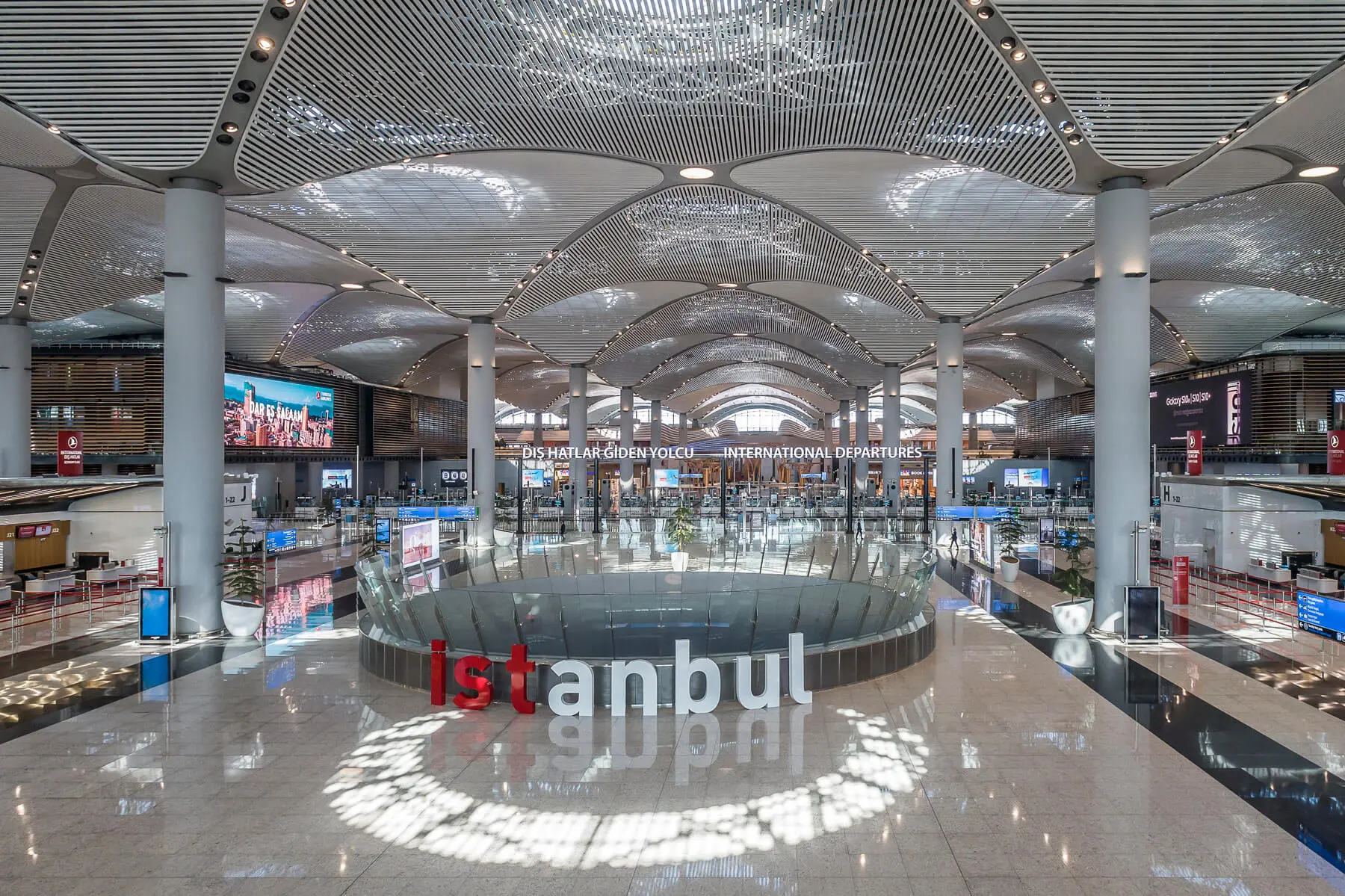
Istanbul Airport (IST) occupies the former Athens airfield site on the European side, 40 kilometers northwest of the city center. The terminal opened in 2018 as a replacement for the old Atatürk Airport, absorbing all commercial and charter traffic. In 2024, DHMI recorded 76.2 million passengers through IST — the highest annual throughput of any single Turkish airport. The airport operates two parallel runways and a single main terminal building (Terminal 1) handling all international and domestic traffic, with a separate CIP (VIP) terminal accessible via a dedicated road on the eastern apron.
The transfer conversation at IST starts here: this is not a compact regional airport. The terminal’s international arrivals hall occupies the ground level of the west wing. Passport control feeds directly into a sterile corridor that splits traffic toward baggage reclaim or the CIP protocol lounge. For standard international arrivals, the distance from the jetbridge to the baggage carousels is 180 meters of corridor — a distance where a standard chauffeur waiting at the arrivals curb will lose a first-time visitor in the crowd every single time.
Understanding that 180-meter corridor and its operational implications is the difference between a smooth VIP arrival and the chaotic experience most travelers describe when recounting their first IST transfer. Our Istanbul VIP transfer guide covers both IST and SAW airports in full operational detail, including the meet-and-greet procedure that applies across both facilities.
How BYZAS Closes the 8-Minute Baggage-to-Chauffeur Gap at IST
IST Terminal 1 international baggage reclaim spans 14 carousels in a single large room. The carousel assignment for each arriving flight updates in real time on THY’s operational system approximately 12 minutes before the first bag drops — a data feed that BYZAS dispatch monitors continuously for every incoming international flight with a confirmed booking.
The operational sequence that BYZAS executes for every IST international arrival:
First, the chauffeur receives the live carousel assignment and a 6-digit flight code 8 minutes before bag drop begins. The chauffeur does not wait at the arrivals curb. Instead, BYZAS protocol positions the chauffeur in the corridor between customs clearance and the carousel room entrance — a staging area overlooked by airport operations staff but not part of the public flow. This positioning cuts 4-5 minutes of walking time from the standard arrivals-curb meet.
Second, client identification uses a QR code system rather than a printed name card. The arriving passenger receives a unique QR identifier via WhatsApp or encrypted email 24 hours before arrival. At IST, the chauffeur displays the QR code on a compact tablet screen. The passenger scans it — confirming identity without any verbal exchange, no name announced, no exposure in a crowded terminal.
Third, luggage handling is coordinated in parallel. Once the carousel assignment is known, a BYZAS porter — stationed inside the reclaim area for all group bookings — collects bags directly from the carousel and wheels them to the vehicle staging zone outside Exit 3. This removes the logistical burden from the passenger entirely.
The Eurasia Tunnel crossing is the fastest surface route from IST to the European Side’s central districts. The tunnel runs beneath the Bosphorus, connecting the airport highway (O-6) directly to thekapi and the disk interior. At off-peak hours, IST to Taksim via the Eurasia Tunnel takes 45-55 minutes. During the morning rush — 08:00 to 10:00 Istanbul local time — the O-1 highway approach into the city adds 20-25 minutes compared to the off-peak baseline. BYZAS dispatch monitors live traffic data via IBBI (Istanbul Metropolitan Municipality Traffic Index) 30 minutes before every scheduled pickup. When O-1 congestion exceeds the threshold, the vehicle reroutes via the D100 highway approach through the city outskirts — slightly longer in raw distance but 15-20 minutes faster during peak windows.
For passengers heading to the Asian Side — Üsküdar, Kadıköy, or the financial district around the Istanbul Financial Center in Ataşehir — the鞍 is mandatory. The ferry crossings at Bosphorus bridges during rush hour add unpredictable delays that the Eurasia Tunnel eliminates entirely.
The Istanbul Airport VIP Terminal (CIP): Who Can Access It and How
IST operates a dedicated CIP (Commercially Important Person) terminal on the eastern apron, physically separate from the main Terminal 1 international arrivals hall. Access is not automatic with a business class ticket. The CIP operates under DHMI protocol regulations and requires pre-registration with the airport authority’s protocol desk minimum 48 hours before the scheduled arrival.
The CIP at IST serves three categories of passengers: accredited diplomats with confirmed protocol status, government officials traveling on official credentials, and corporate VIPs whose organizations hold a standing CIP agreement with the airport authority. THY’s protocol desk manages the registration process for its premium passengers; BYZAS coordinates directly with DHMI’s protocol office independently for non-THY arrivals.
The procedural sequence for a CIP arrival at IST differs from standard international arrivals in three critical ways. First, the aircraft parks at a dedicated CIP stand on the eastern apron, separate from the main commercial ramp. Second, disembarking passengers exit via a private jetbridge that leads directly into the CIP lounge — passport control and customs clearance occur inside the CIP facility, not the main terminal. Third, the vehicle staging lane for the CIP is a secured road on the apron side, accessible only with a DHMI-issued vehicle pass. BYZAS maintains a standing vehicle pass for the IST CIP curbstide, renewed annually through DHMI’s protocol office.
The CIP access distinction matters operationally because passengers using this facility completely bypass the 14-carousel reclaim room, the customs corridor, and the main arrivals curb. Their luggage is handled by CIP porters and delivered directly to the vehicle. BYZAS coordinates with the CIP liaison officer inside the lounge to ensure vehicle staging begins before the passenger exits the building — typically a 3-minute window from lounge exit to vehicle departure.
Our diplomatic chauffeur service guide for Istanbul covers CIP coordination in detail, including the documentation requirements for accredited diplomatic arrivals and the protocol liaison responsibilities that DHMI assigns to ground handling operators.
Armored Transfers from Istanbul Airport: Security Protocol for High-Value Arrivals
Standard luxury sedans handle the majority of IST VIP transfers without complication. However, a distinct operational protocol applies when the arriving passenger requires an armored vehicle — whether B6 or B7 level — due to threat profile, diplomatic accreditation, or personal security preference.
The critical distinction with armored IST transfers is timing: the vehicle does not stage at the arrivals curb. T.C. Interior Ministry regulations require that armored vehicles used for diplomatic transport register their route with local security command 24 hours before the scheduled movement. For unplanned arrivals — which do occur with UHNWI clients — BYZAS activates an expedited registration process through its existing Interior Ministry coordination channel, which reduces the clearance window to approximately 90 minutes.
When THY operates irregular operations at IST (weather, ATC slot restrictions), the airline reroutes arriving aircraft to remote apron stands. On the remote stand procedure, passengers disembark via stair buses to a designated transfer point inside the terminal parking structure. The armored vehicle cannot wait at the remote stand. BYZAS security protocol places the vehicle inside the parking structure’s P3 level — the secured zone closest to the transfer point — and the security coordinator walks the passenger from the bus arrival door directly to the vehicle. This eliminates exposure in open-air transfer zones.
GPS jamming equipment, where legally permitted under the client’s security briefing, is activated only once the passenger is inside the vehicle and the doors are closed. Route deviation from the pre-registered corridor requires notification to the coordination center. Our armored vehicle guide covers the full B6/B7 specification range, vehicle options, and the security driver training standards that apply to this category of transfer.
Flight Disruption Windows: What Happens When Your IST Arrival Is Delayed
THY operates over 340 daily international flights through IST — the largest single-airline international operation at the airport. In 2024, THY’s on-time arrival rate for international flights averaged 76.3% (OAG data). That figure means approximately one in four international arrivals experiences a delay exceeding 15 minutes on any given day.
BYZAS handles IST flight disruptions through a structured tiered response:
For delays under 60 minutes, the assigned chauffeur simply waits. No staging fee, no notification required. The dispatch team monitors the updated ETA continuously and adjusts the vehicle staging position accordingly. For delays between 60 and 90 minutes, BYZAS offers two options: the original chauffeur extends staging (staging fee waived for VIP-tier clients), or an alternative chauffeur is dispatched to ensure coverage if the original chauffeur has a subsequent booking.
For delays exceeding 90 minutes — which typically coincide with ATC slot restrictions, winter weather events at IST, or cascading delays from the originating hub — BYZAS activates the crisis logistics protocol. This includes reassignment to the next available chauffeur, potential vehicle swap for longer-range routes, and direct communication via the encrypted channel established at booking confirmation. Our crisis logistics guide outlines the full disruption response matrix for Istanbul-Ankara corridor alternatives and unscheduled overnight staging.
During irregular operations, the critical operational factor is the disembarkation gate assignment. When IST’s contact stands are occupied, aircraft are parked at remote apron positions requiring bus transfer. BYZAS security coordinators are briefed on the remote stand procedure every quarter and maintain current airport diagramming that shows the P3 parking structure entry points, the bus arrival doors, and the optimal vehicle staging positions for each remote stand zone. This is not theoretical planning — it is tested operational choreography.
Istanbul Airport to the City Districts: Route Logic by Destination
The Istanbul Airport transfer product is not uniform. The correct route and estimated transit time depend on which district the passenger is heading to. Standard transfer operators quote a single “city center” time and let the driver navigate. BYZAS provides district-specific routing with time estimates that account for known congestion windows.
IST to Beşiktaş and Bebek — Both districts sit on the European Side’s northern coast. The fastest approach runs via the O-6 motorway to the Levent interchange, then south through the commercial district. Transit time: 50-65 minutes off-peak, 70-90 minutes during the 08:00-10:00 rush. Beşiktaş’s Ortaköy junction is a known bottleneck on weekends due to tourist traffic along the Bosphorus waterfront.
IST to Ulus and the Istanbul Financial Center (İstanbul Finans Merkezi) — The IFC campus in Ataşehir occupies the Asian Side. The route requires the Eurasia Tunnel crossing. Transit time: 55-70 minutes off-peak. The financial center operates standard weekday hours; morning rush alignment with the 08:30-09:00 opening window means BYZAS typically staggers departures 15-20 minutes earlier for IFC-bound clients to account for tunnel traffic.
IST to the Old City (Sultanahmet) — Sultanahmet’s narrow streets create accessibility constraints. Vehicles cannot always approach the hotel entrance directly. BYZAS pre-coordinates with the property to confirm nearest vehicle drop-off point — typically Alemdar Street or Divan Yolu for the major heritage hotels. Transit time: 60-80 minutes depending on congestion at the Sirkeci junction.
IST to the Princess Islands (Büyükada) — The ferry terminal at Kabataş is the departure point. BYZAS delivers to the terminal curb directly; ferry tickets and seat reservations are pre-arranged for group bookings. Transit to Kabataş: 45-60 minutes via waterfront route. Our Istanbul business travel guide covers district routing logic for the Ankara corridor — relevant for passengers connecting from IST to government destination travel.
The common thread across all district routes: BYZAS dispatch issues a single confirmation message to the passenger 24 hours before arrival containing the chauffeur name, vehicle plate, vehicle photo, and a live tracking link. No ambiguity. No wrong vehicle. The Istanbul Airport arrival experience begins with information clarity, not chaos.